


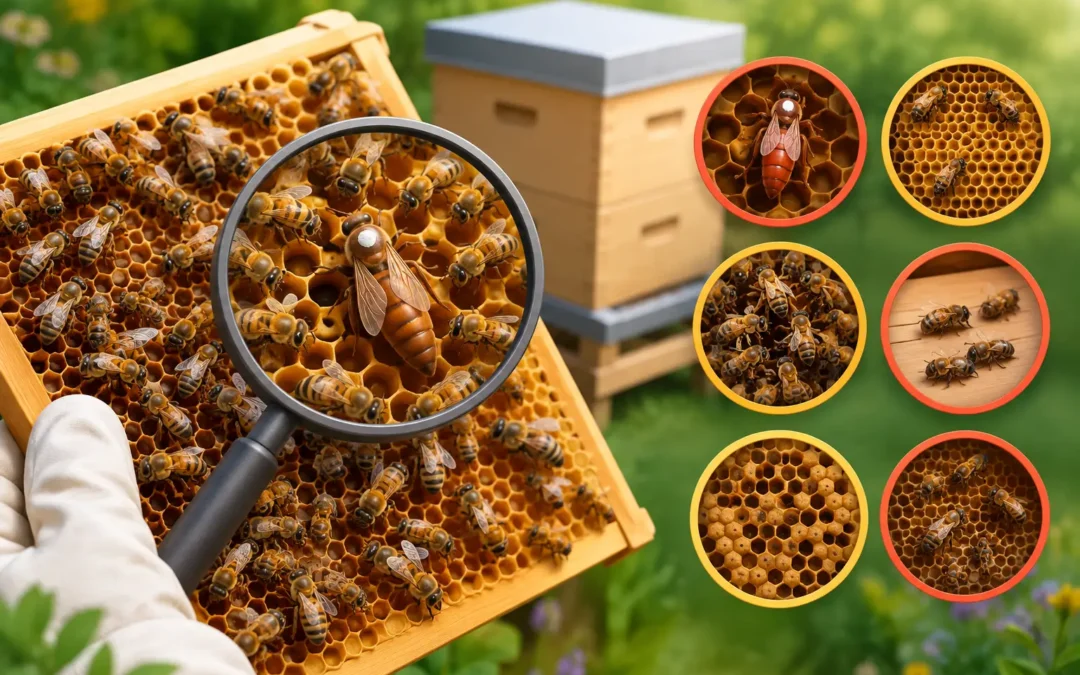
A colony can look busy at the entrance and still be losing its queen’s performance inside. Recognizing the top signs of failing queens early gives a beekeeper time to act before a once-promising colony becomes weak, overly defensive, or unable to prepare for winter. The goal is not to replace every queen that produces an imperfect frame of brood. It is to read the whole colony carefully and make decisions based on a consistent pattern.
For beekeepers working with Carniolan bees, this matters especially in spring and early summer. Carniolan colonies can build quickly when nectar and pollen are available. A queen that cannot maintain a balanced brood nest may leave the colony behind just when the main flow begins.
Top Signs of Failing Queens to Watch For
A failing queen is not always old, and a young queen is not automatically successful. Mating quality, injury, disease pressure, nutrition, weather during mating, and colony conditions can all affect her performance. The clearest evidence comes from repeated inspections, not one unusual frame.
A scattered or shrinking brood pattern
A healthy, well-mated queen usually produces compact areas of worker brood, particularly when the colony has adequate food, space, and a reasonable population of nurse bees. Small gaps are normal. Empty cells may hold pollen or nectar, and workers may remove unhealthy larvae.
Concern begins when the brood pattern is consistently patchy across several central frames. You may see capped brood scattered among many empty cells, with few eggs and young larvae available to replace emerging bees. If the brood area continues to shrink during favorable weather and a nectar flow, the queen may be running out of sperm or laying inconsistently.
Before blaming the queen, check for varroa pressure, brood disease, chilled brood, pesticide exposure, and a shortage of pollen. A poor pattern can also result when the colony simply lacks enough workers to care for a larger brood nest.
Excess drone brood in worker cells
A queen that has exhausted her stored sperm can lay unfertilized eggs. These eggs develop into drones. When drones are raised in worker-sized cells, their cappings often look noticeably raised or bullet-shaped among otherwise flat worker brood cappings.
This is a serious warning sign, but it needs careful interpretation. Drone brood near the edge of the brood nest or in larger drone comb is entirely normal. The concern is widespread drone brood in worker cells, especially paired with a declining worker population and few properly developing worker larvae.
Multiple eggs or eggs placed poorly
Fresh eggs are useful evidence, but they must be read in context. A newly mated queen may occasionally place more than one egg in a cell while she settles into a steady laying pattern. That can correct itself within a short time.
However, multiple eggs attached to cell walls rather than centered on the bottom can point to laying workers. This often happens after a colony has been queenless for too long. A failing queen can lead to this situation if she has stopped laying or has disappeared without the colony raising a viable replacement.
If you suspect laying workers, look for the queen before assuming she is present. The colony may still behave as though it has a queen because it has open brood or because workers are laying.
Repeated supersedure cells
Queen cells are not always a sign of failure. Colonies raise cells for swarming, emergency replacement, and supersedure. Their location and the colony’s condition matter.
Supersedure cells are often found on the face of the comb, rather than mainly along the lower edge. When a colony with adequate room and no strong swarm impulse repeatedly starts one or two queen cells, workers may be trying to replace a queen they judge as underperforming. Reduced brood quality, an injured queen, or declining pheromone production can trigger this response.
Do not destroy supersedure cells automatically. If the current queen is failing, removing those cells may delay the colony’s natural recovery. On the other hand, a colony that is already small or entering a poor season may not have the resources or mating weather needed for successful replacement.
A population that does not match the season
Colony strength should follow local conditions. In a productive spring, a healthy Carniolan colony should expand with available forage while maintaining a well-organized brood nest. If neighboring colonies are building and one colony remains noticeably weak, inspect it closely.
A failing queen often creates a delayed decline. The colony may still contain many older foragers, so it appears active from outside. Inside, there are too few eggs, larvae, and capped worker cells to replace bees that are aging out. Over several weeks, the imbalance becomes obvious.
This can be particularly damaging after the main honey flow. A colony that has not produced enough young workers may struggle to rear the long-lived bees needed for wintering. Requeening early enough gives the new queen time to establish a strong brood cycle before conditions tighten.
Changes in temperament without another clear cause
Temperament is not a diagnosis by itself. Poor weather, repeated disturbance, robbing pressure, wasps, hunger, queenlessness, and rough handling can all make a colony defensive. Still, a previously calm colony that becomes persistently unsettled deserves attention.
Queen pheromones help organize colony behavior. When a queen is failing or absent, workers may become more restless on the comb and more defensive at the entrance. Look for this change alongside brood evidence rather than treating it as proof on its own.
At MS Carnica Queens, calm behavior is evaluated together with spring development, hygienic behavior, wintering ability, and productive potential. No single trait tells the full story of a colony’s genetic or practical value.
How to Confirm a Queen Problem
Give yourself enough time to inspect deliberately. Find eggs and assess whether they are consistently present. Then examine several brood frames, noting the amount of open brood, capped worker brood, drone brood, pollen, and stores. Compare what you see with the colony’s strength, local forage conditions, and the date.
A useful approach is to inspect again after seven to ten days when the situation is uncertain. A queen may temporarily reduce laying during a dearth, after poor weather, or when the colony is crowded. A truly failing queen usually shows the same weak pattern again, while a healthy queen responds when conditions improve.
If you cannot find the queen but see eggs, she was present within the last three days. If there are no eggs, no young larvae, and the colony has a restless queenless character, look for emergency cells and consider whether the colony can raise a replacement in time.
A test frame containing eggs and very young larvae from a healthy colony can help confirm queenlessness. If the colony builds emergency queen cells on that frame, it likely lacks a functional queen. Use this method carefully and avoid weakening donor colonies, particularly during periods of limited forage or high disease pressure.
When Requeening Is the Better Choice
Requeening is usually the practical choice when poor brood quality persists, the worker population is declining, or the colony is unlikely to raise and mate a replacement successfully. It is often better to act before the colony becomes too small to accept a queen or support her first brood.
Natural supersedure can work well when weather is stable, drones are available, and the colony is strong. Yet it carries uncertainty. A virgin queen needs favorable mating flights, and a failed mating period can cost several more weeks of brood production. This trade-off is especially relevant late in the season or in areas with unsettled weather.
When introducing a new queen, remove the old queen only after you have confirmed the replacement is available and the colony’s condition supports introduction. Follow a calm, standard introduction process and avoid opening the colony repeatedly during acceptance. A queen cage is not a substitute for assessing stores, disease status, varroa management, and colony population.
A good queen cannot compensate for every management problem. She can, however, give a healthy, adequately resourced colony the steady brood pattern and orderly development it needs. Regular records from spring through fall make those quiet changes easier to see, and they allow you to intervene while the colony still has a strong future ahead.