


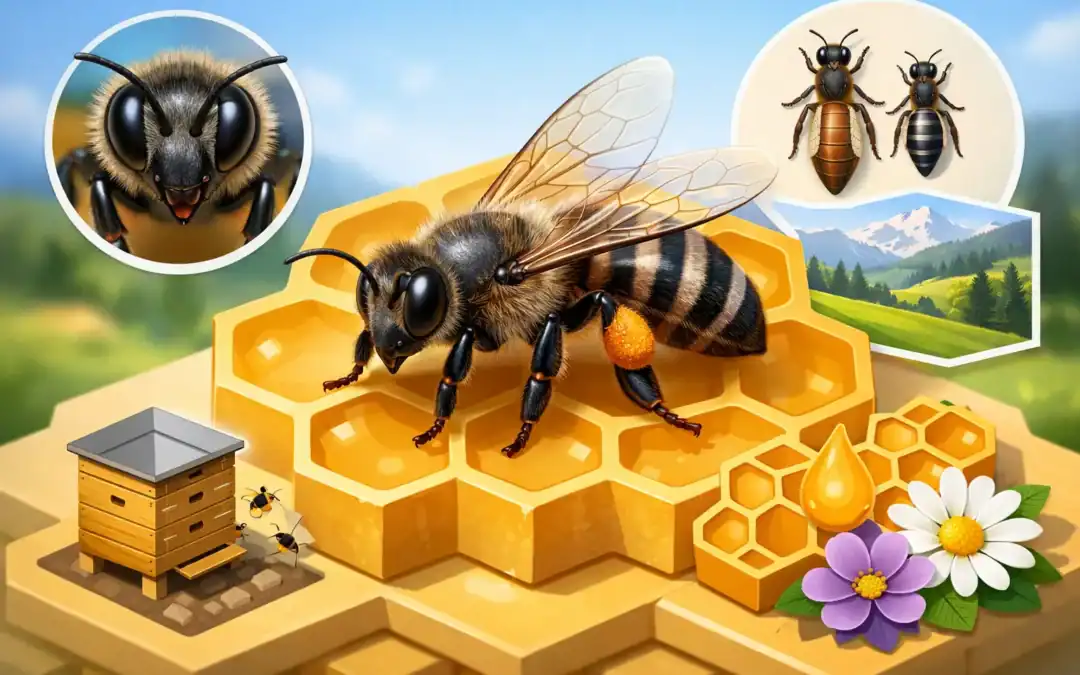
A colony that comes through a long winter on modest stores, builds quickly when pollen arrives, and remains workable on a cool spring inspection is showing the qualities many beekeepers associate with the Carniolan bee. The most valued Apis mellifera carnica characteristics are not isolated traits. They work together, and they are best judged over a full season rather than during one good inspection.
For beekeepers choosing queens or breeding stock, this distinction matters. A calm colony that cannot winter well is not enough. Fast spring buildup without swarm management can become a problem. Productive, sustainable colonies result from sound genetics, careful selection, appropriate forage, and practical husbandry.
Apis mellifera carnica characteristics in the apiary
Apis mellifera carnica, commonly called the Carniolan honey bee, originates from the region around Slovenia and neighboring parts of Central and Southeastern Europe. It is well suited to areas with cold winters, changeable springs, and distinct nectar flows. Its long relationship with this landscape is one reason authentic Carniolan genetics are so valued by beekeepers across Europe.
Calm temperament and practical handling
Carniolan bees are widely known for their gentle disposition. Well-bred colonies are generally calm on the comb, allowing routine inspections with less disturbance than more defensive stock. This is particularly useful for hobby beekeepers, organic operations, and apiaries near homes, livestock, or public areas.
Temperament still depends on conditions. A colony may become defensive when queenless, short of forage, heavily disturbed, or under pressure from predators and pests. Weather also changes bee behavior. For that reason, responsible breeding evaluates calmness repeatedly under normal working conditions, not on one unusually favorable day.
A quiet colony is not simply more pleasant to manage. It enables more accurate brood checks, better queen assessment, and less unnecessary smoke. These small advantages add up over a busy season.
Rapid spring development
Strong spring development is one of the defining Carniolan traits. When pollen and nectar become available, a healthy colony can expand brood rearing quickly and prepare well for early flows. In regions where fruit trees, oilseed rape, acacia, or spring wildflowers provide a short but important harvest window, this responsiveness can be a real advantage.
However, fast growth requires attention. Colonies need adequate space before they become crowded, and young queens should be monitored as the population rises. A beekeeper who waits until every box is full may find swarm cells already underway.
The goal is not maximum brood at every moment. The better outcome is a colony whose growth matches local forage and whose population is ready when the main nectar flow begins. In a poor or delayed spring, feeding decisions, hive insulation, and colony strength may matter as much as genetics.
Thrifty wintering ability
Carniolan bees have a strong reputation for wintering efficiently. They tend to reduce brood rearing as the season closes and maintain a compact winter cluster. When colonies enter winter healthy, adequately provisioned, and with a well-mated queen, this can support lower food consumption than colonies that maintain excessive late brood.
This trait is valuable, but it should not be misunderstood as a reason to leave colonies without sufficient stores. Winter losses can result from varroa pressure, viruses, moisture, poor ventilation, inadequate food, or late-season queen failure. Good genetics improve a colony’s potential; they do not replace careful preparation.
In our Slovenian environment, wintering ability is a central part of breeder-colony evaluation. A colony must prove itself after the winter, not merely look strong during the summer. Spring survival, the condition of the queen, food use, and the quality of the first brood cycle all provide meaningful information for selection.
Productivity linked to colony balance
Carniolan colonies can be productive honey producers when their development is aligned with local nectar flows. Their rapid response to spring forage helps them build a workforce in time for harvest. Yet honey yield should never be treated as the only measure of quality.
A colony that produces heavily in one exceptional season but swarms repeatedly, winters poorly, or shows weak brood hygiene is not ideal breeding material. Sustainable production depends on balance: a good queen, a stable worker population, healthy brood, sufficient food reserves, and management suited to the location.
For this reason, breeder selection should use collected colony data across seasons. Honey production has value, but it belongs beside temperament, vitality, winter survival, brood pattern, and hygienic behavior.
Hygiene instinct and colony health
Hygienic behavior is another important Apis mellifera carnica characteristic in modern breeding. Bees with a good hygiene instinct can identify and remove unhealthy or damaged brood more effectively. This behavior supports colony cleanliness and is a useful part of a wider health strategy.
It does not mean a colony is automatically resistant to every disease or parasite. Varroa management remains essential, particularly in organic beekeeping where prevention, monitoring, and timely approved treatments must be carefully planned. Hygienic behavior should be viewed as one layer of resilience, alongside low disease pressure, strong nutrition, clean comb management, and thoughtful treatment decisions.
A breeder should assess hygiene with a consistent method and compare colonies under similar conditions. Selecting only for appearance or honey yield can overlook the traits that help an apiary remain healthy over time.
The trait that needs management: swarm tendency
Carniolan bees are responsive to changing forage conditions, and that responsiveness can include a pronounced swarm tendency if colonies become crowded. This is the trade-off most often mentioned when discussing the breed.
Good queen selection can reduce excessive swarming, but no responsible breeder should promise that swarm prevention comes entirely from genetics. A rapidly developing colony needs room, timely inspections, and management that reflects local weather and bloom conditions. Splitting colonies, adding supers, renewing queens, and removing swarm cells when appropriate all remain practical tools.
The best Carniolan colonies combine strong spring development with manageable swarm behavior. Breeding toward that balance requires patient observation, because swarm tendency is influenced by the queen, colony age, space, forage interruptions, and beekeeper timing.
What authentic selection looks like
The name Carniolan should mean more than a color pattern or a label on a queen cage. Authentic Apis mellifera carnica breeding begins with a population adapted to its native region and continues through documented selection of breeder colonies.
At MS Carnica Queens, colonies are evaluated in real production conditions for calm temperament, spring development, honey potential, hygienic behavior, wintering performance, and overall vitality. Naturally mated queens are produced from this practical work in the Slovenian countryside, where Carniolan bees remain part of the local beekeeping heritage.
For buyers, it is sensible to ask how queens are selected, which traits are recorded, how colonies winter, and whether the breeder works under certified organic standards. Clear answers are more useful than broad claims about “best genetics.” A trustworthy queen producer can explain what is measured and why.
Choosing Carniolan queens for your location
A Carniolan queen may be an excellent choice for an apiary with cold winters and important spring or early-summer nectar flows. They are also often appreciated by beekeepers who value calm colonies and careful, low-stress handling. But local adaptation remains essential.
Consider your forage calendar, winter length, typical spring weather, varroa pressure, and how often you can inspect colonies during swarm season. A queen with rapid buildup may be ideal for one operation and too demanding for another where inspections are infrequent. Introducing quality genetics is most successful when management gives those genetics the right conditions to show their value.
A well-selected Carniolan queen does not turn beekeeping into a fixed recipe. She gives the colony a sound starting point: calm workers, efficient wintering, timely growth, and the capacity to gather well when nature offers a flow. The lasting results come from observing that colony closely and working with its seasonal rhythm.