


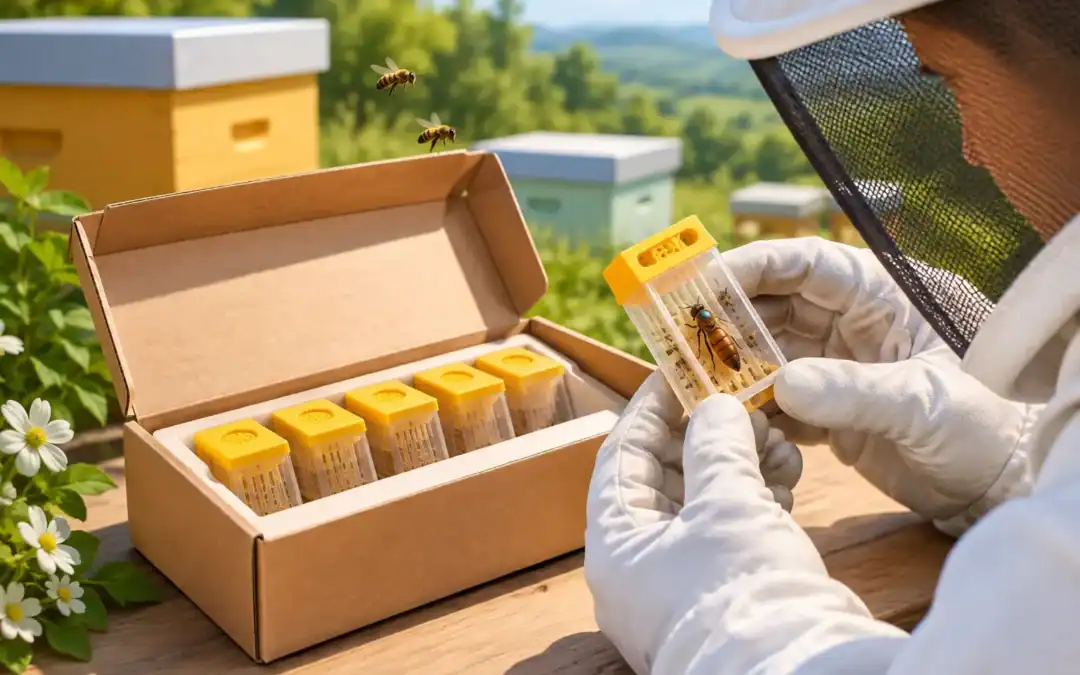
A queen shipment quality review begins at the moment the parcel is opened, not after the queen starts laying. A healthy, carefully bred Carniolan queen can still face stress in transit, while a calm arrival does not by itself prove that every part of the shipment was well managed. Looking closely at the cage, attendants, handling conditions, and the colony’s response gives a fairer picture of quality.
For beekeepers investing in selected genetics, this inspection is also good husbandry. It helps distinguish a transit issue from an introduction issue, and an introduction issue from a concern that may genuinely relate to queen quality.
What a quality queen shipment should show on arrival
Open the outer packaging promptly in a quiet, shaded place. Avoid leaving the shipment in a hot vehicle, direct sun, or a cold draft while preparing the receiving colony. The goal is to assess the queen without adding another stressful event.
The cage should be intact, clean, and securely closed. A small amount of wax, candy residue, or movement debris is normal. Wetness, crushed cage material, leaking feed, or many dead attendants are warning signs that the shipment may have experienced difficult conditions. Record these details with clear photographs before changing anything.
The queen should be visible and moving normally. A well-conditioned queen generally walks with purpose, holds her wings correctly, and has no obvious injury to her legs, abdomen, or wings. She may be less active after transport, particularly after temperature changes, so stillness alone is not a final judgment. Give her a few moments in moderate light and observe calmly.
Attendant bees are part of the shipment quality picture. They should be alive in reasonable number and able to care for the queen. A few losses can occur during travel. Extensive mortality, especially combined with a dry cage or an overheated parcel, deserves attention because attendants regulate and feed the queen during shipment.
Check the candy and moisture balance
Candy should be present, protected from excessive heat, and firm enough that the queen cannot become trapped in it. Very hard, dry candy can delay release. Soft or melted candy can foul the cage and create a risk for the queen. The cage should not be soaking wet, but it should also not appear severely dried out.
These details are influenced by season and route. A shipment that travels well in mild spring weather may need different packing protection during a summer heat period. Quality is not the absence of every possible transit effect. It is thoughtful preparation, appropriate materials, and a queen that arrives in sound condition.
Queen shipment quality review: inspect the receiving colony too
A queen cannot be evaluated separately from the colony asked to accept her. Many disappointing introductions begin with a queenless unit that is not truly queenless, a colony with laying workers, or a nucleus that is too weak, hungry, or disturbed to respond well.
Before installation, confirm that the receiving colony has no virgin queen, no hidden mated queen, and no queen cells. If there is doubt, do not rush the release. A colony can reject an excellent queen if it still recognizes another queen’s pheromone or has begun producing laying workers.
The receiving bees should have enough young workers, food stores, and brood to form a stable unit. For a small nucleus, balance matters more than sheer bee numbers. A crowded box of older, defensive bees with little brood is often less suitable than a modest unit with emerging brood and nurse bees.
Place the cage between brood frames where the bees can cluster around it. Do not shake bees off the cage or repeatedly open it to check progress. The bees’ behavior offers useful information: calm feeding through the cage mesh is generally encouraging, while persistent biting, balling, or aggressive clustering calls for patience and another inspection of colony queen status.
Do not judge genetics in the first week
The first seven to 10 days are mainly about survival, release, and acceptance. A queen may need time to settle, mate-related stress may show briefly, and laying can be delayed by poor weather, a weak nucleus, or a shortage of open cells. Immediate heavy laying is welcome, but it is not the only acceptable outcome.
Once the queen is released, allow the colony to organize itself before opening again. Then look for eggs placed centrally in cells, a developing pattern of worker brood, and a calm colony response during normal handling. One scattered patch of brood is not enough to reach a conclusion, particularly in a recently made nucleus. The pattern should be assessed as the brood nest develops over several inspections.
A quality Carniolan queen should be considered in the context of her environment. Spring development, honey flow, forage availability, varroa pressure, colony strength, and beekeeper management all influence performance. Traits such as calm temperament, hygienic behavior, wintering ability, and productivity are best observed over a season, not inferred from the first brood frame.
Keep a record that supports a fair assessment
A simple arrival record turns impressions into useful information. Note the delivery date and time, outside conditions, cage condition, attendant survival, queen appearance, colony strength, introduction method, release date, and the first evidence of eggs. Photographs of the unopened parcel, cage, and later brood pattern can be valuable if a question needs to be discussed with the breeder.
This record also improves future purchasing and management decisions. If several queens arrive well but acceptance is inconsistent, the cause may be in the preparation of receiving colonies. If a particular route repeatedly exposes shipments to heat or delay, adjusting delivery timing may be more useful than changing genetics.
At MS Carnica Queens, breeder colonies are evaluated under production conditions for vitality, spring buildup, temperament, hygienic behavior, and wintering performance. That long-term selection work is meaningful only when queens are introduced into suitable colonies and given a reasonable period to show their potential.
When to contact the breeder
Contact the breeder promptly if the queen is dead on arrival, visibly injured, missing from a damaged cage, or accompanied by unusually high attendant mortality. Share photographs and the shipment details before disposing of packaging or altering the cage. A clear, early report allows the situation to be assessed fairly.
If the queen arrives alive but is not accepted, first confirm the colony’s condition. Check for hidden queens, queen cells, laying workers, and signs of robbing or starvation. If she is accepted but does not begin laying within a reasonable period, report the full introduction timeline rather than only the final result. This helps separate a queen concern from a colony or weather-related delay.
Quality is shown in the weeks that follow
A careful shipment protects the queen through a vulnerable journey, but the real value of selected breeding becomes visible gradually. Give the colony adequate food, space, and calm handling. Watch how it builds brood, how it behaves on the comb, and how it maintains strength when conditions change.
The most useful queen shipment quality review is therefore both immediate and patient: inspect the arrival closely, introduce the queen correctly, and let consistent colony performance provide the answer.