


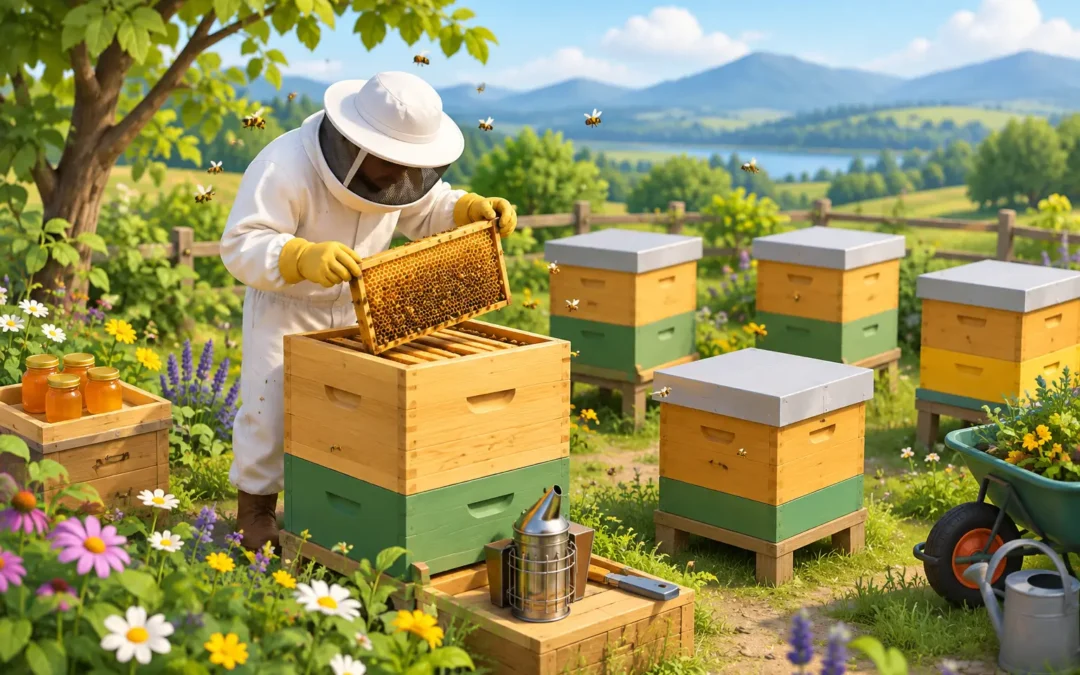
A clean hive is not automatically an organic hive. The real work of how to maintain organic apiaries happens across the entire season: choosing a suitable site, protecting forage, selecting resilient queens, watching colony health closely, and recording every decision. Organic beekeeping asks for active husbandry, not simply fewer inputs.
For a family apiary or a larger professional operation, the aim is the same: colonies that can develop naturally, produce well within their environment, and winter with enough strength to begin again in spring. Strong Carniolan genetics can support this goal, but genetics only perform as well as the management around them.
Start With the Apiary Site and Forage
An organic apiary begins with its surroundings. Bees range widely, so no beekeeper can control every field or garden within flight distance. What you can control is where hives are placed, how local risks are assessed, and whether colonies have access to varied forage through the season.
Choose a site away from obvious contamination sources, including heavily sprayed crops, industrial activity, busy roads, and waste storage. A sheltered location with morning sun, dry ground, clean water, and good airflow helps colonies regulate temperature and moisture. Damp, shaded sites often create more work, particularly during cool springs and long winters.
Forage matters just as much as location. A short, intense nectar flow may fill supers, but it does not necessarily provide balanced nutrition from spring through fall. Look for a landscape with trees, wildflowers, meadows, hedgerows, and late-season pollen sources. Where forage gaps are common, work with neighbors or landowners to encourage bee-friendly planting and reduced pesticide use.
Organic certification requirements differ by country and certifying body. Keep current with the rules that apply to your apiary, particularly regarding location, feed, wax, treatments, and recordkeeping. Certification is a documented production system, not a claim made at harvest time.
Choose Queens for Health, Not Just Honey Yield
A productive colony is valuable, but honey yield alone is not a breeding plan. In organic management, queen selection should give equal weight to temperament, spring development, brood pattern, hygienic behavior, wintering ability, and colony vitality.
Carniolan bees are valued for their calm handling, efficient use of spring flows, and ability to winter well when managed correctly. Still, every queen should be assessed in the conditions where her daughters work. A colony that looks excellent during one strong nectar flow may reveal weaknesses in brood health, swarming tendency, or winter survival later in the year.
Replace queens from colonies that repeatedly show poor brood patterns, excessive defensiveness, weak recovery, or low resistance to disease pressure. Avoid breeding from colonies simply because they survived after being neglected. Survival is useful information, but reliable breeding decisions come from systematic observations over time.
At MS Carnica Queens, breeder colonies are evaluated under real production conditions. This kind of selection supports beekeepers who need queens that are not only gentle and productive, but also suited to long-term colony management.
How to Maintain Organic Apiaries Through Regular Inspections
Organic beekeeping does not mean opening colonies constantly. It means inspecting with a purpose. During the active season, assess brood, queen status, food stores, space, temperament, and signs of disease or pests. The interval depends on weather, nectar flow, colony strength, and the time of year.
In spring, confirm that colonies have enough food before expansion accelerates. A cold spell can interrupt forage when brood rearing is already increasing. Starvation at this stage may happen quickly, even in colonies that appeared well supplied a week earlier.
During the main season, give strong colonies adequate room before congestion leads to swarming. Add supers or brood space according to your system and local flow. Swarm prevention should not rely on repeated disruption alone. Young, well-mated queens, balanced colony strength, and timely space management are more dependable foundations.
Later in the season, reduce unnecessary inspections and focus on preparation. Colonies need enough time to raise healthy winter bees, organize stores, and settle before cold weather. Every opening should answer a clear question.
Manage Varroa With Monitoring and Timely Action
Varroa destructor remains one of the central challenges in organic beekeeping. Ignoring it in the name of natural management is not organic and is not responsible. Heavy mite pressure weakens developing bees, spreads viruses, reduces winter survival, and can affect neighboring apiaries.
Monitor infestation levels using a consistent method and record the results. Alcohol or detergent washes provide a useful estimate of mites on adult bees; other methods may be used when appropriate, but they should be interpreted carefully. Regular data is more valuable than occasional impressions.
Use only measures permitted by your certification standard and apply them at the correct time. Treatment choice depends on temperature, brood status, honey supers, local regulations, and resistance risk. Organic-approved products can still fail when timing, dosage, or colony conditions are wrong.
Brood interruption, drone brood removal, and hygienic stock may reduce pressure, but they are not universal replacements for treatment. Their value depends on the colony and season. The practical goal is to bring mite levels down early enough for healthy winter-bee production, rather than reacting after visible damage has appeared.
Keep Wax, Feed, and Equipment Traceable
Wax carries a long memory. Residues can accumulate in comb over many seasons, which is why organic apiaries need a careful wax policy. Use traceable wax that meets the requirements of your certification program, renew old comb gradually, and keep brood comb separate from honey comb where practical.
Feeding should be preventive only when colony welfare requires it, not a substitute for leaving adequate honey stores. Record why feed was given, what was used, when it was supplied, and which colonies received it. If emergency feeding is needed, act early. Waiting for a colony to collapse does not preserve its natural strength.
Good records also cover queen origin, colony movements, inspections, disease findings, harvests, treatments, wax changes, and winter losses. They help meet certification obligations, but their daily value is greater: records show patterns that memory misses. A recurring late-summer decline, for example, may point to forage shortage, queen failure, or varroa pressure.
Prepare for Winter Before Fall Arrives
Wintering begins while colonies are still raising brood in late summer. Healthy, long-lived winter bees require low mite pressure, a sound queen, sufficient stores, and a hive that stays dry without becoming poorly ventilated.
Combine weak colonies when there is a clear benefit, rather than carrying several marginal units into winter. Check that entrances are protected as needed from mice and that hives are stable against wind. Avoid sealing colonies so tightly that moisture becomes a larger threat than cold.
The right winter setup depends on local climate, hive type, and colony size. In colder inland areas, wind protection and food reserves may be the priority. In milder, damp areas, ventilation and moisture control often deserve more attention. Inspect externally through winter when conditions allow, but avoid breaking the cluster without a reason.
Organic apiaries stay healthy through attentive decisions made well before a problem becomes visible. Read the landscape, select queens from proven colonies, measure pest pressure, and leave clear records behind every intervention. That steady care gives each colony the best chance to meet the next spring with calm strength and purpose.