


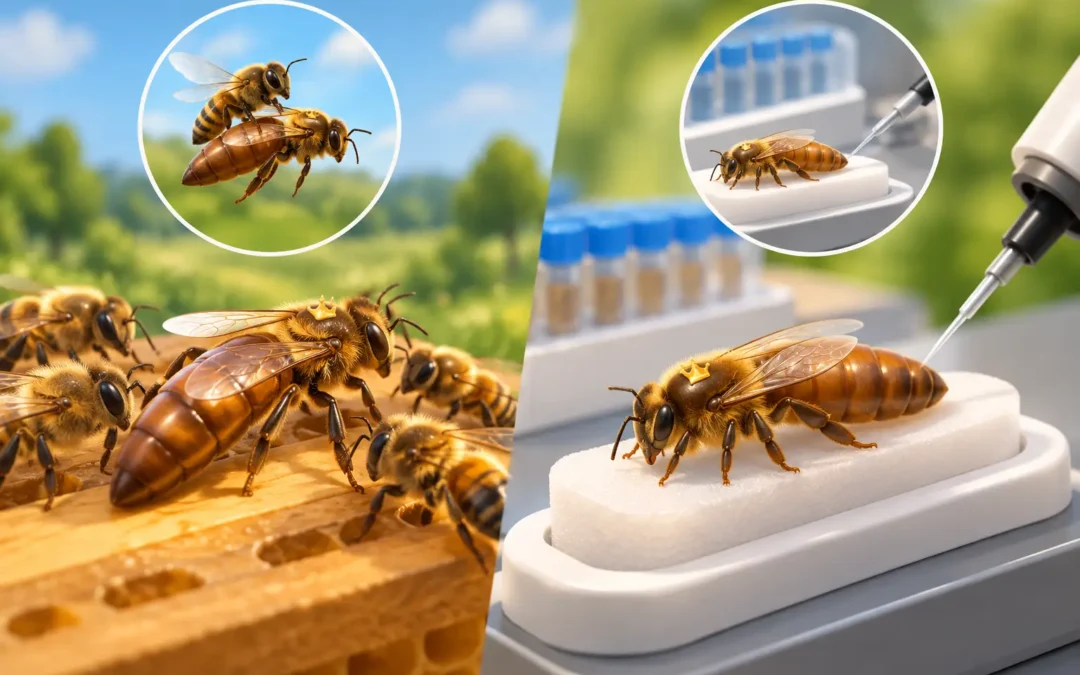
A replacement queen is not simply a replacement queen. The way she was mated influences the genetics entering an apiary, the information available about her parentage, and sometimes the way a breeding program can progress. For beekeepers comparing naturally mated versus inseminated queens, the right choice depends less on a universal ranking and more on the purpose of the queen.
At MS Carnica Queens, our work is centered on carefully selected, naturally mated Carniolan queens raised from colonies evaluated under real apiary conditions. Natural mating is especially valuable when the goal is a productive, well-balanced queen for a working colony. Instrumental insemination has a different and highly useful role, particularly in controlled breeding and genetic preservation.
What naturally mated queens offer
A naturally mated queen takes mating flights and mates in drone congregation areas, usually with several drones. She stores sperm for the rest of her productive life, allowing her to lay fertilized eggs consistently without needing to mate again.
This process brings a degree of natural selection. A queen must fly well, locate drones, mate successfully, and return to the colony. Drones also compete to mate. These are meaningful biological filters, though they do not replace careful breeder selection by the beekeeper.
For a queen producer, the main variable is the local drone population. If an apiary is located in an area with many unmanaged colonies or unknown bee types, the paternal side cannot be predicted with precision. That does not automatically make the resulting queen poor, but it limits certainty about the traits she may pass on.
Well-managed mating areas reduce this uncertainty. Isolated locations, strong selected drone colonies, and thoughtful timing improve the likelihood that virgin queens mate with drones carrying desired genetics. In Slovenia, the long heritage of the Carniolan honey bee gives responsible breeders an especially strong foundation for maintaining authentic local stock.
The value of instrumental insemination
Instrumental insemination, often called artificial insemination, allows a breeder to select the exact drone source for a virgin queen. Semen is collected from chosen drones and introduced into the queen under controlled conditions. This gives the breeder a known maternal and paternal combination.
That control is invaluable when testing a breeding line. A breeder may want to examine how the daughters of one highly hygienic colony perform when paired with drones from a colony known for excellent wintering ability. Without controlled mating, it is difficult to separate inherited traits from the broad variation of open mating.
Instrumental insemination is also an important conservation tool. It can preserve a rare or valuable line when suitable mating conditions are unavailable, when a selected drone line must be maintained, or when breeding work requires accurate pedigree records over several generations.
The method requires skill, hygienic handling, suitable equipment, and careful queen management. A successfully inseminated queen can become an excellent mother queen, but she should be given appropriate time and conditions to begin laying. The technique itself does not create better genetics. It gives a capable breeder more precise control over which genetics are combined.
Naturally mated versus inseminated queens in practice
For most honey producers, organic beekeepers, and hobbyists, a naturally mated queen from a transparent breeding program is the practical choice. The queen should come from breeder colonies selected for traits that can be observed where they matter: calm behavior on the comb, spring buildup, honey production, brood pattern, hygienic behavior, winter survival, and general vitality.
A naturally mated queen also introduces useful genetic diversity into a production apiary. Because she commonly mates with multiple drones, her worker population contains several paternal subfamilies. This can support colony-level resilience, although colony results will still depend on forage, weather, disease pressure, management, and available drones.
Inseminated queens are usually best viewed as breeding tools rather than standard production queens. They are often used to create daughter queens, establish breeder colonies, or retain carefully documented lines. A commercial beekeeper may use an inseminated queen at the top of a breeding program while filling production colonies with naturally mated daughters.
Neither approach should be judged by mating method alone. An inseminated queen from weak or insufficiently tested stock is not automatically valuable. Likewise, a naturally mated queen from carefully selected mothers and a well-managed mating environment may be an outstanding choice for a working apiary.
Genetic certainty and field performance
The central difference is straightforward: instrumental insemination offers greater certainty about paternity, while natural mating offers a more open biological process with less exact paternal control. This distinction matters most when making breeding decisions, not necessarily when choosing a queen for one colony.
Field performance remains the final test. A queen can have an impressive pedigree and still perform poorly in a particular location. Good breeding therefore combines records with repeated observation. Colonies must be assessed across seasons, including spring development, nectar flows, periods of drought, disease pressure, and wintering.
For Carniolan bees, traits should be considered as a whole. Fast spring development is desirable only when colonies remain balanced and can be managed responsibly. Gentle behavior is valuable, but it should be accompanied by sound productivity and a dependable hygiene instinct. Strong wintering matters because it reflects both the queen’s genetics and the colony’s ability to use stores efficiently.
Questions to ask before buying
When selecting a queen, ask how the breeder chooses mother colonies and whether those colonies are evaluated in normal production conditions. Ask about the mating environment, the local bee population, health management, and how queens are checked before dispatch.
For an inseminated queen, ask which maternal and drone lines were used, why that pairing was made, and whether the queen is intended for breeding or direct production. For a naturally mated queen, ask whether the breeder maintains selected drone colonies and whether the area supports the local race being bred.
Traceability matters in both cases. A responsible breeder should be able to explain the work behind the queen without making promises that no living colony can guarantee. Weather, forage, varroa management, nutrition, and beekeeper decisions all shape the outcome after installation.
Choosing for an organic apiary
Organic beekeeping places additional value on prevention, colony vitality, and adaptation to local conditions. Queens that head calm, productive colonies with good hygiene behavior can help reduce stress in the apiary, but they are part of a wider husbandry system rather than a substitute for it.
For many organic operations, naturally mated Carniolan queens fit well with a practical, field-based approach to selection. They reflect mating and colony development under natural conditions while benefiting from disciplined evaluation of their maternal lines. This is particularly meaningful when queens are raised by a breeder who works with their own colonies throughout the season.
Instrumental insemination can also serve organic-minded breeding by safeguarding selected genetics and supporting long-term improvement. The question is not whether one method is more modern or more natural. It is whether the method serves healthy, adaptable colonies and a clear breeding purpose.
A queen choice that matches your goal
Choose a naturally mated queen when you want a well-selected, practical queen for a production colony and value performance proven in real apiaries. Choose an inseminated queen when precise parentage is necessary for planned breeding, testing, or conservation work.
The most reliable path is to match the queen to the job, then give her colony the conditions needed to show its potential. Good queens begin with good genetics, but their real value is seen later – in calm inspections, solid brood nests, healthy winter clusters, and bees working steadily when the honey flow arrives.