'/%3E%3C/svg%3E)


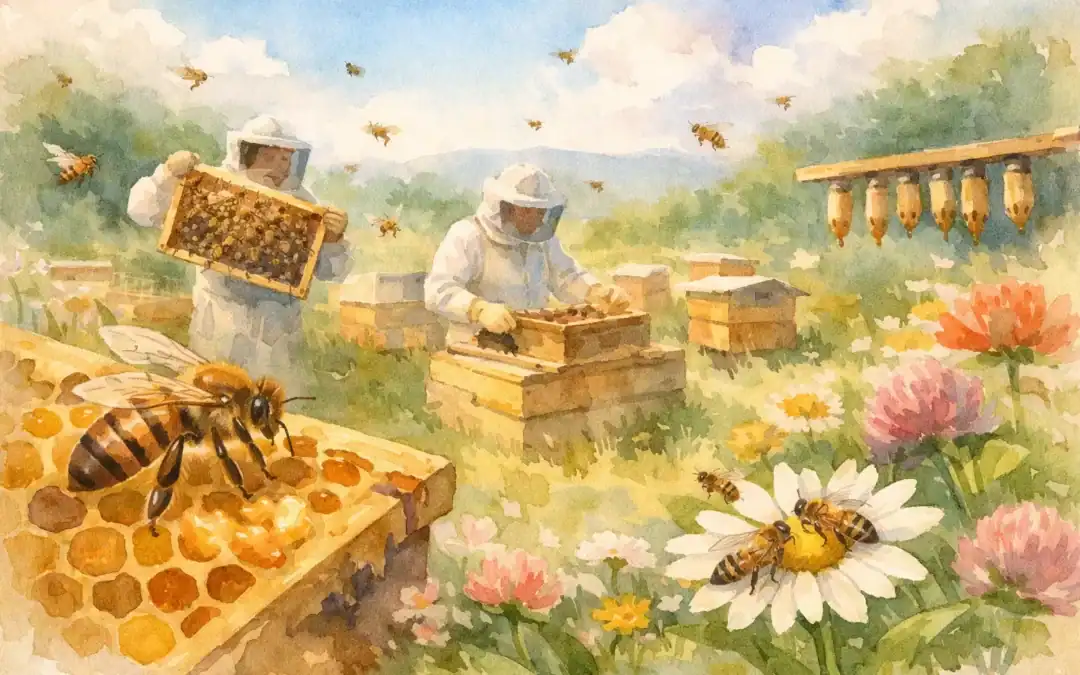
Beekeepers who value organic management and long-term colony health should ask not only where a queen was produced, but also how her maternal line was evaluated, the conditions under which the colonies live, and whether the breeder can explain the work behind the queen. It is how her maternal line was evaluated, under which conditions the colonies live, and whether the breeder can explain the work behind the queen.
What Good Queen Breeders Actually Select For
A serious breeding program begins with colonies, not with queen cells. Breeder colonies should be observed repeatedly through the active season and assessed after winter. One pleasant inspection or one strong honey harvest does not provide enough information to make sound breeding decisions.
At MS Carnica Queens, selection is based on colony performance in working apiaries in the Slovenian countryside. This matters because colonies are measured under real conditions: changing weather, local nectar flows, routine inspections, and normal wintering. The goal is not a queen that performs well only in an isolated test situation, but genetics that support practical beekeeping.
Calm behavior is one of the clearest qualities a beekeeper notices. A colony that stays composed during inspections is easier to manage and more pleasant to work. However, gentleness alone is not enough. A colony also needs steady spring development, a compact brood pattern, healthy vitality, and the ability to prepare properly for winter.
Honey production potential is part of the picture, but it should be interpreted carefully. Yield depends on forage, weather, colony strength, management, and the timing of nectar flows. Breeders should therefore look for colonies that consistently build to useful strength and make good use of the conditions available to them, rather than promising a fixed harvest.
Hygienic behavior also deserves close attention. Colonies with a good hygiene instinct can better recognize and remove compromised brood. This is a valuable trait within a broader health plan, though it is not a substitute for careful monitoring of mites, disease prevention, sound nutrition, and responsible treatment decisions.
Why Carniolan Genetics Need Local Understanding
Authentic Carniolan honey bees, Apis mellifera carnica, are part of Slovenia’s beekeeping heritage. They are valued for their calm disposition, responsive spring development, and ability to winter efficiently when managed well. These traits make them attractive to beekeepers across Europe, especially where seasons can change quickly and winter stores must be used carefully.
Still, no bee type removes the need for good beekeeping. Carniolan colonies can expand rapidly when pollen and nectar become available. That can be an advantage before an early flow, but it also means the beekeeper must provide room, inspect at the right time, and manage swarm pressure. Good genetics give a colony potential. The apiary environment and the beekeeper’s decisions shape the outcome.
Local adaptation is another reason to look beyond broad labels. A queen reared in a healthy colony from proven local lines has experienced a breeding system shaped by a particular landscape and climate. Slovenian Carniolan breeding carries that connection to the region, while systematic evaluation helps identify colonies whose useful traits are repeated rather than assumed.
Naturally Mated Queens and Mating Conditions
Naturally mated queens are shaped by more than their mother colony. Their mating success and the surrounding drone population also matter. Responsible queen production requires careful timing, healthy mating nuclei, adequate nutrition, and conditions that allow young queens to return safely and begin laying well.
For many beekeepers, naturally mated queens are a practical choice because they fit established apiary management and reflect mating under normal field conditions. The trade-off is that mating cannot be controlled as tightly as it can in an instrumental insemination program. This makes the quality of the breeding environment, drone sources, and colony evaluation especially important.
A supplier should be able to describe whether queens are naturally mated, how they are checked before dispatch, and how breeder colonies are selected. A newly laying queen should show a consistent brood pattern before she is sent to a customer. Shipping a queen too early may save time in the short term, but it does not serve the beekeeper receiving her.
Questions to Ask Queen Breeders Before Ordering
The strongest questions focus on evidence and husbandry rather than marketing language. Ask how breeder colonies are evaluated across the season and whether winter survival is part of selection. Ask about temperament, brood quality, hygienic behavior, and the production setting where the lines are tested.
It is also reasonable to ask about traceability. Beekeepers seeking organic stock should understand whether the operation is certified, what the certification covers, and how colonies are managed. Organic production is not just a label on honey. It reflects documented practices, apiary management, feed choices where needed, and a commitment to working with bees in a way that respects their biology.
Availability is another practical subject. Quality queen production follows the season. Weather affects mating flights, colony development, and the timing of queen readiness. A breeder who gives realistic delivery windows is usually protecting quality rather than creating uncertainty. Ordering early and planning replacement or expansion work around the local season makes the process easier for both sides.
Finally, consider communication after purchase. A queen may arrive in excellent condition and still need thoughtful introduction. The receiving colony’s queenlessness, population, stores, and temperament all affect acceptance. A responsible breeder provides clear information, while a careful beekeeper follows it and avoids rushing the introduction.
Building an Apiary Around Better Queens
Replacing queens can solve specific problems, but genetic improvement works best as a planned process. Keep simple records for each colony: the queen’s year, spring buildup, temperament, brood quality, swarm tendency, honey crop, health observations, and winter outcome. Over several seasons, these notes reveal which lines truly suit your locations and management style.
Avoid judging a queen too quickly. A newly introduced queen needs time for her own workers to emerge before her influence is fully visible. A colony’s early behavior may still reflect the previous queen’s workers, poor weather, a weak forage period, or problems that began before requeening. Patience produces better decisions than replacing queens repeatedly without identifying the cause.
For expansion, nucleus colonies and production colonies can be as important as individual queens. A well-balanced nucleus with a laying queen, brood, food, and enough workers gives a new line a more stable beginning. The right choice depends on the beekeeper’s experience, season, equipment, and goal. A queen may be ideal for requeening established colonies, while a nucleus may better suit a beekeeper building numbers carefully.
The best relationship with a breeder is not a one-time transaction. It is a practical partnership built on clear records, honest expectations, and respect for the annual rhythm of the bees. Choose queens from people who can show how they select, care for, and evaluate their colonies, then give those queens the calm, well-managed home they need to prove their value.