


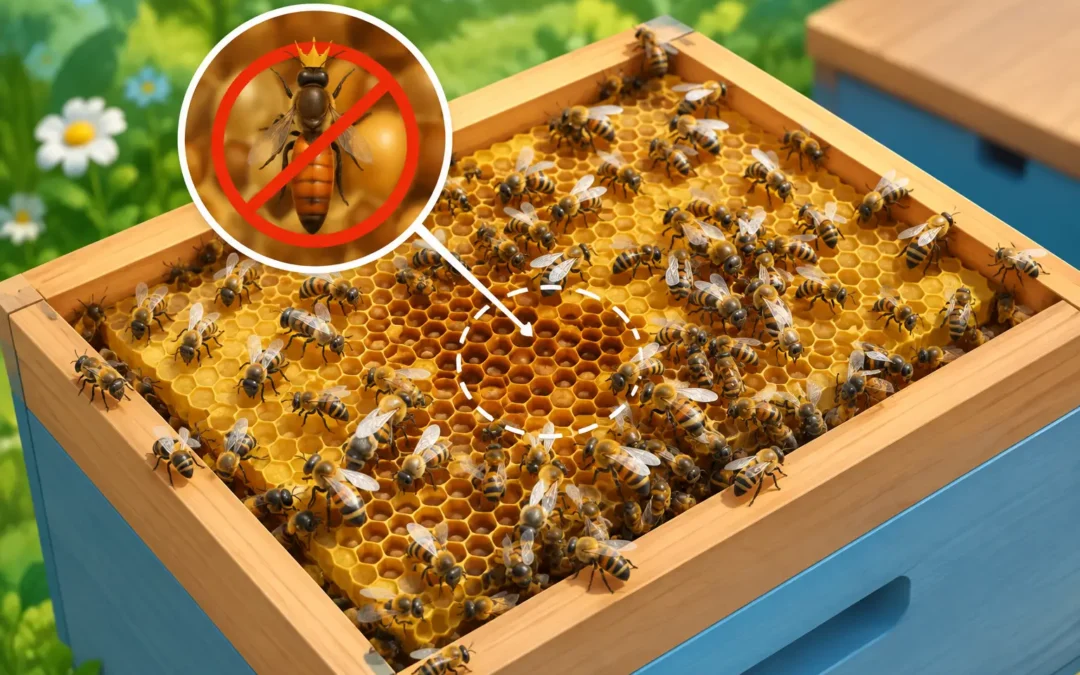
A colony can look busy at the entrance and still be heading toward trouble. For that reason, the top signs of queen failure are best found inside the hive: in the brood pattern, the age balance of bees, and the colony’s behavior over several inspections. A queen does not need to disappear completely to become a problem. She may be present, laying a few eggs, and no longer supporting the colony’s future strength.
For beekeepers who depend on productive, well-wintered colonies, early recognition matters. A weak queen can leave too few healthy workers for a nectar flow, reduce the colony’s ability to manage pests, or create a small winter cluster when autumn arrives. At the same time, not every irregular brood pattern means the queen has failed. Weather, a recent swarm, disease pressure, and a newly mated queen can all create temporary changes.
Top signs of queen failure to watch in the brood nest
The most useful inspection starts with the brood frames. Look at more than one frame and assess the pattern as a whole rather than judging the queen by a single empty patch.
A scattered or spotty brood pattern
A strong laying queen normally produces a compact area of brood, with eggs, larvae, and capped cells developing in a consistent pattern. Some gaps are normal. Worker emergence, pollen storage, and damaged cells all create open spaces.
Concern begins when the brood looks scattered across the frame, with many empty cells among capped brood and no clear area of younger larvae. This can indicate that the queen is laying poorly, has limited sperm, or is aging. In a colony with adequate pollen and nectar, a persistently patchy pattern deserves attention.
Before blaming the queen, inspect carefully for varroa-related brood damage, chalkbrood, foulbrood symptoms, or chilled brood. A queen cannot create a solid brood pattern if workers are removing unhealthy larvae or if the colony is under heavy stress.
Too few eggs and young larvae
Eggs and very young larvae are the colony’s clearest evidence of a functioning queen. If a colony has only capped brood and older larvae, it may be queenless, or it may have had a recent interruption in laying.
A brief brood break can be normal after swarming, during poor weather, after transport, or when a young queen is mating. In colder periods, particularly in areas with changeable spring conditions, a queen may also reduce laying temporarily. Give the colony enough time to show its true condition, but do not wait indefinitely if its adult bee population is shrinking.
When eggs remain scarce over repeated inspections during a season of available forage, the colony is unlikely to build the workforce it needs. This is one of the most practical signs that requeening should be considered.
Drone brood in worker cells
A failing queen that has run out of stored sperm can lay unfertilized eggs. These produce drones, including in worker-sized cells. The caps often look raised and uneven, sometimes described as a bullet-shaped pattern.
This is different from ordinary drone brood along the lower edge of a frame. Colonies naturally raise some drones, especially in spring. The concern is widespread drone brood across the worker brood area, combined with a declining worker population.
Multiple eggs in a cell can point to laying workers rather than a queen. Laying workers usually place eggs irregularly on cell walls, while a queen usually places a single egg near the bottom of the cell. By the time laying workers are established, introducing a new queen can be difficult because the colony may reject her.
A queen that is present but underperforming
Seeing the queen is reassuring, but it is not the final answer. An old, injured, poorly mated, or diseased queen may still move normally on the comb while producing an inadequate brood pattern.
Assess performance through colony results. Is the brood nest expanding when neighboring healthy colonies are developing? Does the colony maintain enough young bees to cover brood? Is it consistently weaker than comparable colonies despite having food, space, and reasonable mite control? A visible queen with poor brood quality can be more misleading than an absent one.
Colony behavior that can signal a queen problem
Worker behavior gives useful context, especially when eggs are hard to find. Queenless colonies may sound more agitated when opened and may run nervously over the comb. They can also be unusually defensive, although temperament alone is never enough to diagnose queen failure.
A colony that is queenless for several days may build emergency queen cells around young larvae. These cells are a clear signal that the bees believe they need a replacement. However, queen cells can also appear during swarm preparation or supersedure, so their location and the colony’s brood condition matter.
Supersedure cells, often one or two well-formed cells in the center or lower part of a brood frame, may mean the colony is quietly replacing an aging queen. A strong colony can sometimes manage this process well without interference. Opening the hive too often or destroying every queen cell can interrupt a replacement that the bees have already judged necessary.
The practical question is whether the colony has enough eggs and young brood, enough bees, and enough time in the season to raise and mate a quality queen. In areas with uncertain weather or limited drone availability, waiting for a natural replacement carries more risk.
Rule out other causes before requeening
Good queen management is based on observation, not haste. First confirm that the colony has sufficient stores and pollen. Nutritional stress can reduce brood rearing quickly. Then consider the season, local forage conditions, recent weather, and whether the colony may have swarmed.
Varroa monitoring is essential. Heavy mite pressure can weaken emerging bees, shorten worker life, and make a colony appear queenless or failing when the queen is only part of the problem. Viral symptoms, deformed wings, crawling bees, or a rapidly declining population require a broader colony-health response.
A young queen deserves patience. After mating, she may take time to begin laying consistently, and her first brood pattern may not be perfect. Reinspect after an appropriate interval rather than disturbing her every few days. A mature queen with a declining pattern during a productive season is a different situation.
When a replacement queen is the sensible choice
Requeening is usually most successful when the colony still has enough workers to care for brood and accept a new queen. Waiting until the population has collapsed can turn a straightforward correction into a difficult rescue.
A carefully selected Carniolan queen (Apis mellifera carnica) can help restore brood continuity, calm colony behavior, and seasonal development, but genetics work best when the receiving colony is healthy and adequately provisioned. Resolve obvious disease, severe mite pressure, or starvation first. A new queen should not be asked to overcome conditions that would weaken any colony.
Before introducing her, make certain the old queen is removed. Check again for emergency queen cells after the colony has recognized her absence. Introduction method depends on colony strength, season, and the temperament of the bees, but slow release generally gives workers time to accept a new queen’s pheromones.
At MS Carnica Queens, breeder colonies are evaluated under real production conditions for traits that matter after installation: spring development, vitality, calm behavior, hygiene instinct, honey potential, and wintering ability. Even excellent genetics, however, need sound colony management and regular inspection to show their value.
A queen’s performance is not measured by how easily she is found on a frame. It is measured by the healthy, balanced colony she maintains. When brood quality remains poor, the adult population falls, and other causes have been ruled out, timely action gives the colony its best chance to recover before the season closes.