


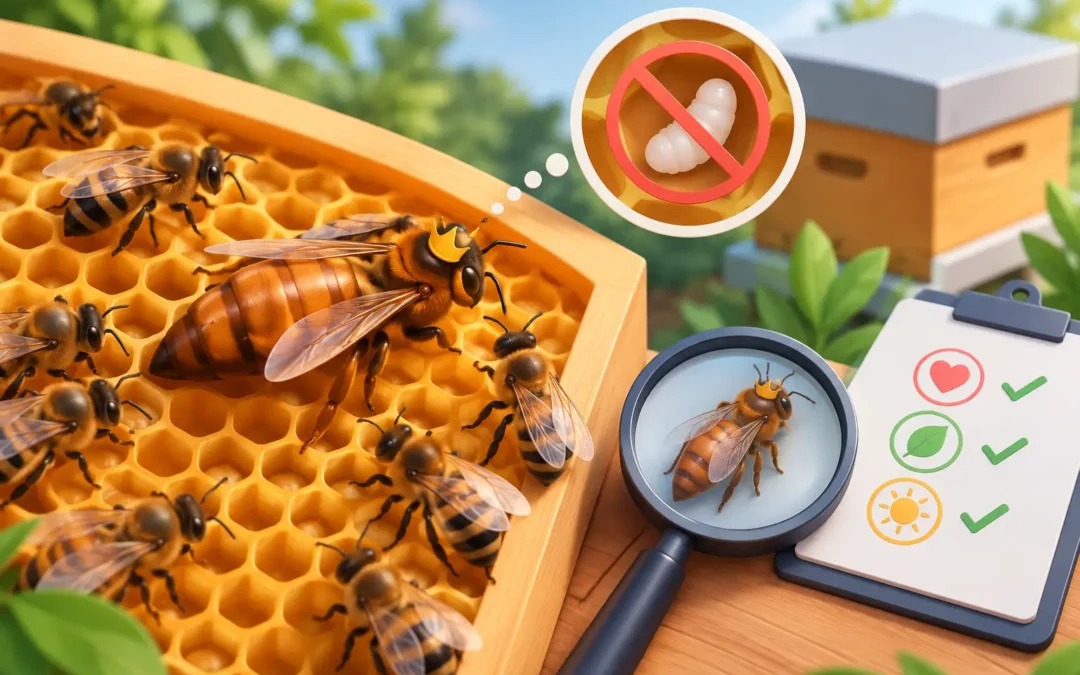
A queen that has stopped laying can change the whole mood of an apiary. Brood production slows, foragers age without replacement, and a strong colony can become difficult to manage quickly. When beekeepers ask, why do queens stop laying, the answer is rarely just that the queen is old or poor. Season, colony condition, food intake, swarm preparation, and queen status all need to be considered together.
A calm inspection and a careful reading of the brood nest usually provide more useful information than a rushed search for the queen herself. In a well-managed Carniolan colony, brood rearing naturally responds closely to forage and weather. That responsiveness is a strength, but it also means a temporary pause can have several causes.
First, confirm that laying has truly stopped
A reduced brood area is not the same as a laying stop. During a nectar dearth, a cold spell, or late-season contraction, the queen may lay in a much smaller area than expected. Look for eggs in polished cells near the remaining brood. Fresh eggs are easy to miss in poor light, so tilt the frame gently and inspect it with the sun behind you.
If there are no eggs, larvae, or sealed worker brood, check when the colony was last known to be queenright. Also look for queen cells, especially open cells with royal jelly or sealed cells along the lower edges and face of brood frames. Their presence can point to swarming, supersedure, or emergency queen replacement.
The pattern matters. A queen with a small but solid patch of worker brood may simply be responding to limited conditions. Scattered brood, many empty cells, or a sudden absence of young brood can suggest a queen problem, disease pressure, or an interruption in mating and replacement.
Seasonal brood breaks are often normal
Honey bees do not raise brood at the same rate throughout the year. Even productive colonies reduce laying when incoming nectar and pollen decline. In areas with hot, dry summers, brood rearing may contract sharply during a dearth. In cooler climates, a prolonged rainy period can produce a similar effect because foraging becomes restricted.
Carniolan bees are especially known for building quickly when spring forage is available and reducing brood rearing when conditions no longer support it. This helps colonies use winter stores efficiently, but it can surprise beekeepers who expect a large brood nest to remain constant.
In fall, a reduction in laying is normally part of preparing a colony for winter. The important question is whether the colony is producing enough healthy young bees for wintering. A late-season colony with limited brood, adequate stores, low mite pressure, and a good queen may be entirely normal. A colony that becomes broodless too early, is light on stores, or contains aging bees deserves closer attention.
Swarming can interrupt egg laying
A queen may reduce laying before a swarm leaves because the colony is preparing for reproduction. A slimmer queen flies more readily, so worker bees may restrict her feeding and reduce the available laying area. Congestion in the brood nest, a lack of drawn comb, and a rapidly expanding spring population can all contribute.
Once the old queen has departed, the remaining colony is temporarily broodless while a daughter queen emerges, matures, mates, and begins laying. Under favorable weather, this process still takes time. Cold, wind, rain, or a shortage of mature drones can extend the wait and increase the risk that a virgin queen will not mate successfully.
Do not destroy queen cells automatically. If the old queen is gone, those cells may be the colony’s only route to replacement. Instead, assess the timeline. A sealed queen cell generally indicates that the colony is already in transition. Avoid repeated inspections while a virgin queen may be preparing for mating, as unnecessary disturbance can delay the process.
Supersedure and queen age can be quieter causes
Colonies often replace a queen without swarming. This is called supersedure. It may happen when the queen is aging, has been injured, is poorly mated, or is no longer producing enough queen pheromone. The colony may remain calm and keep only a small number of well-positioned queen cells, often on the face of a brood frame rather than in a crowded row at the bottom.
An older queen does not always fail suddenly. More often, the brood pattern becomes less compact, the brood nest stays smaller despite good forage, or the queen lays more drone brood than expected. However, drone brood alone is not proof of failure. Colonies naturally raise drones in spring and early summer, and drone production varies with season and genetics.
A poorly mated queen can also begin well and decline early. If her supply of stored sperm is limited, she may increasingly lay unfertilized eggs, producing drones in worker cells. This is one reason careful breeder selection, mating conditions, and honest colony evaluation matter when choosing replacement queens.
Food, space, and colony stress affect the queen
The queen depends on worker bees to feed her and prepare cells for laying. When nectar or pollen is scarce, workers may reduce feeding and the brood nest contracts. A colony can have honey stores and still lack the fresh pollen or incoming nutrition needed to maintain strong brood rearing.
Space is equally practical. If the brood chamber is clogged with honey, pollen, or nectar, the queen has fewer empty cells available. This often occurs during a sudden flow when supers are added too late or when the brood nest is not given enough drawn comb. Before blaming the queen, look at whether she has suitable open cells in the center of the nest.
High Varroa pressure, viral infections, Nosema, pesticide exposure, overheating, and repeated disturbance can also weaken the workforce that supports brood rearing. These issues do not always make the queen stop immediately, but they can create a colony condition in which laying falls away. In organic beekeeping, the best response begins with observation, prevention, good nutrition, hygienic stock, and treatment decisions that follow the applicable organic standard.
A practical inspection sequence
When eggs disappear, work through the colony in a consistent order. Start with the youngest brood, then look for queen cells, food reserves, available laying space, and signs of disease or pests. Notice the colony’s behavior as well. A queenless colony may sound more restless and react differently to smoke, but behavior alone is not a reliable diagnosis.
If a virgin queen is likely present, give the colony time and avoid opening it every few days. If there is no brood, no viable queen cell, and no credible reason to expect a new queen, act promptly. The colony may need a frame containing eggs and very young larvae so it can demonstrate whether it can raise a queen. Alternatively, it may be better to introduce a tested, mated queen, depending on the season, colony strength, and available resources.
Always consider the calendar. Requeening a weak colony late in the season is not the same decision as replacing a failing queen during a strong spring flow. A small colony may be better combined with a healthy one than asked to rear a new queen when drones, weather, or forage are unfavorable.
When replacement is the sensible choice
Replacement is usually justified when the colony has no viable route to a queen, when a queen consistently produces a poor brood pattern under good conditions, or when the colony is too weak to recover from a long brood break. It can also be the better choice when a known, productive queen provides more certainty than waiting for an untested emergency queen.
A quality Carniolan queen should be assessed as part of a colony, not as an individual insect in a cage. Calm behavior, spring development, hygienic behavior, wintering ability, vitality, and productive brood rearing are all colony-level traits. At MS Carnica Queens, breeder colonies are evaluated under real production conditions because reliable genetics must perform beyond the day a queen is introduced.
The most useful habit is to keep clear inspection notes. Record the date, brood stages present, queen cells, food condition, mite monitoring results, and weather or forage changes. Over a season, these notes turn an uncertain brood break into a pattern you can understand. A queen that pauses for a natural reason needs patience; a colony showing a true failure needs timely, thoughtful support.